Exploring how neurodiverse teams could increase innovation
Oct 30, 2025
Imagine you're about to embark on a Dungeons & Dragons campaign. Or, if you're more familiar with Tolkien than tabletop roleplay, think of Frodo setting off from Rivendell with a fellowship of wildly different companions to destroy the One Ring and defeat the dark lord Sauron. It's not a coincidence that the group included representatives of the diverse races of Middle Earth - elves, humans, dwarves, wizards, and hobbits. The strength of that team came from its differences in culture, temperament, and skills.
Good teams in real life operate the same way. I believe we benefit from having contrast and range within a team. Teams that include a variety of cognitive styles, including neurodivergent thinkers, are uniquely equipped to expand what a team is capable of even imagining. This expansion of perspective is the core reason to prioritise neurodiversity. Opportunity space -the range of solutions your team can consider - is simply larger when your thinking styles are more varied. And in industries that thrive on new ideas and execution, that expansion is a competitive edge.
What Is Opportunity Space?
Opportunity space refers to the range of possible solutions a team can generate when working on a problem. Think of it as a landscape of ideas, approaches, and perspectives. Homogenous teams often stay clustered in one corner of that landscape; efficient, perhaps, but narrow. When we broaden the mental models in the room, we widen the map and remove the "fog of war." You discover routes you didn't even know existed.
In fields like techbio where new approaches are essential, we may not need fancy solutions, but we might need to imagine entirely different ways of solving problems. Some may be elegantly simple but invisible to teams stuck in best-practice loops.
Assembling the Fellowship
Much like Tolkien's Fellowship had its strategist (Gandalf), its rogue (Aragorn), and its bard (Merry), strong workplace teams form ecosystems themselves. People naturally take on roles based not just on titles, but on how they process information, how they react under pressure, and what they notice that others don't. These roles often go unnoticed in recruitment but I think they are crucial to team performance.
Neurodivergent team members often fall into some distinct patterns - this is not to generalise, but in this case a heuristic or increased empathy could be useful. Someone with ADHD might be the high-output idea generator, seeing alternative routes and dead-ends long before others do. They may be able to make intuitive leaps that others cannot follow that turn out to be good judgements. An autistic colleague might catch subtle inconsistencies in experimental design or push for clarity when others settle for ambiguity. By min-maxing the skills on the individual level in the team we can create a team that has strengths in all areas.
In this way, neurodivergent contributions can be incredibly useful in innovation-driven environments. When neurotypical and neurodivergent perspectives interact, the opportunity space could grow non-linearly with solutions that require the diverse expertise of the team that no one individual could have created.
Paths Less Travelled
Innovation is an incredibly expensive non-linear process with many mistakes, dead ends and distractions. Innovations within a scientific discipline can be relatively slow and incremental. There are however, some tricks I would employ to help it along. Some of these are especially suited to the natural way that Neurodivergent people work and think. For ADHD individuals, the intuitive pattern recognition can spark connections between seemingly unrelated areas giving rise to unconventional approaches. Who would have believed two hobbits could trudge all the way to mount doom carrying the ring of Power to destroy it; surely a vast army would be better suited, no?
Intuition as Fuel for Innovation
An area where people with ADHD could excel is in identifying connections between seemingly unconnected areas, enabling cross domain innovation. In the literature there is a consistent finding that those with ADHD-like symptoms have higher levels of divergent thinking (Hoogman et al. 2020, Stolte et al. 2022), a property regularly associated with creativity . This tendency to form surprising but relevant connections between domains, sometimes through unconscious pattern recognition, is something that neurodivergent people experience as intuition. I think it is an undervalued skill as it is not usually measured in interview processes.
Through some analogical thinking we can see that mundane established fact in one domain could remove the stumbling blocks in another. Let's look at an example. RA Fisher, completely changed biology through the use of statistics, and helped turn Biology into an information science. Although not a formally trained as a biologist, RA Fisher played an incredibly important role in the development of statistical inference methods for Biology and Psychology We'll leave to the the side any controversy around his views on eugenics.
Another example is the development of modern AI models - the neural network. This came about because a group of researchers including Sir Geoffrey Hinton, the "Godfather of AI", believed AI could be modelled on the human brain and how it processes information. Indeed the layered structure of convolutional neural networks mirrors almost exactly the layered structure of the human visual cortex and we can even see that different layers in the neural networks and visual cortex are doing similar jobs: edge detectors, face neurons etc.
Expanding Opportunity Space in Practice
If we think back to our Fellowship of The Ring analogy, The fellowship got "lucky" when instead of having to pass over the Carhadras mountain and nearly being killed, that they had other opportunities: The Gap of Rohan, and the ill-fated trip into Moria. The whole story may have finished on the side of a mountain if it were not for the opportunities afforded by the diverse team.
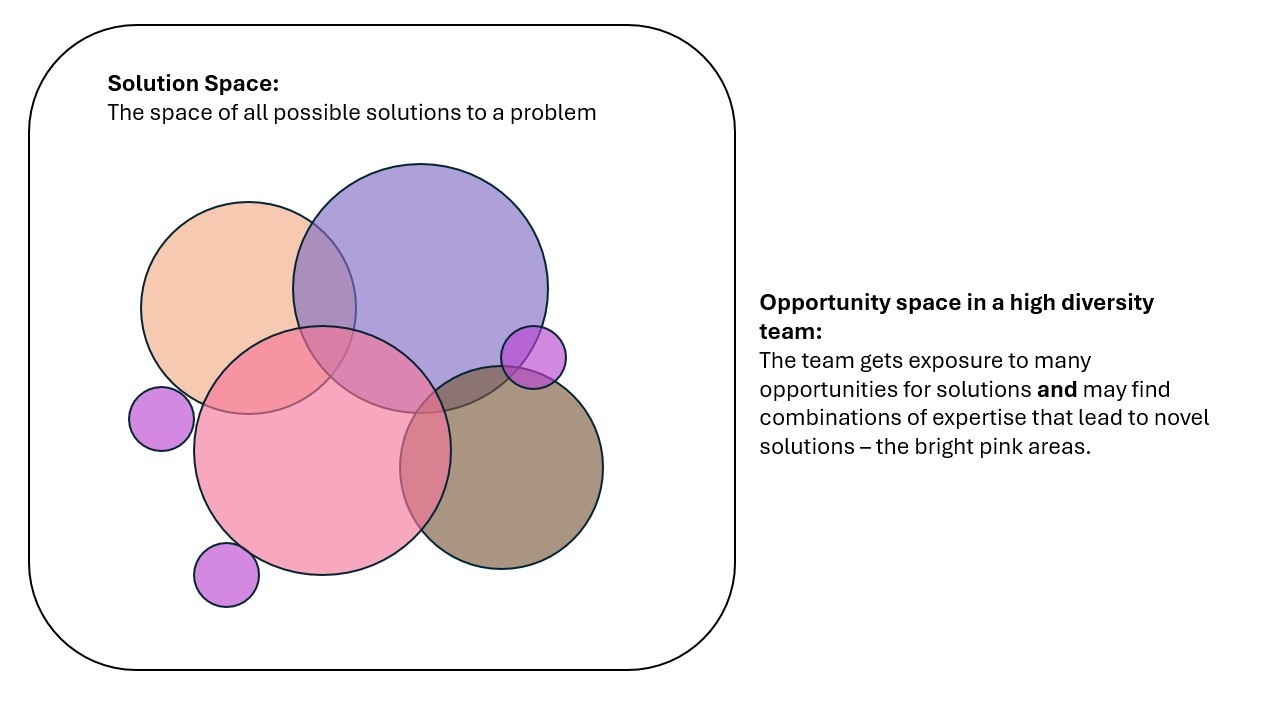
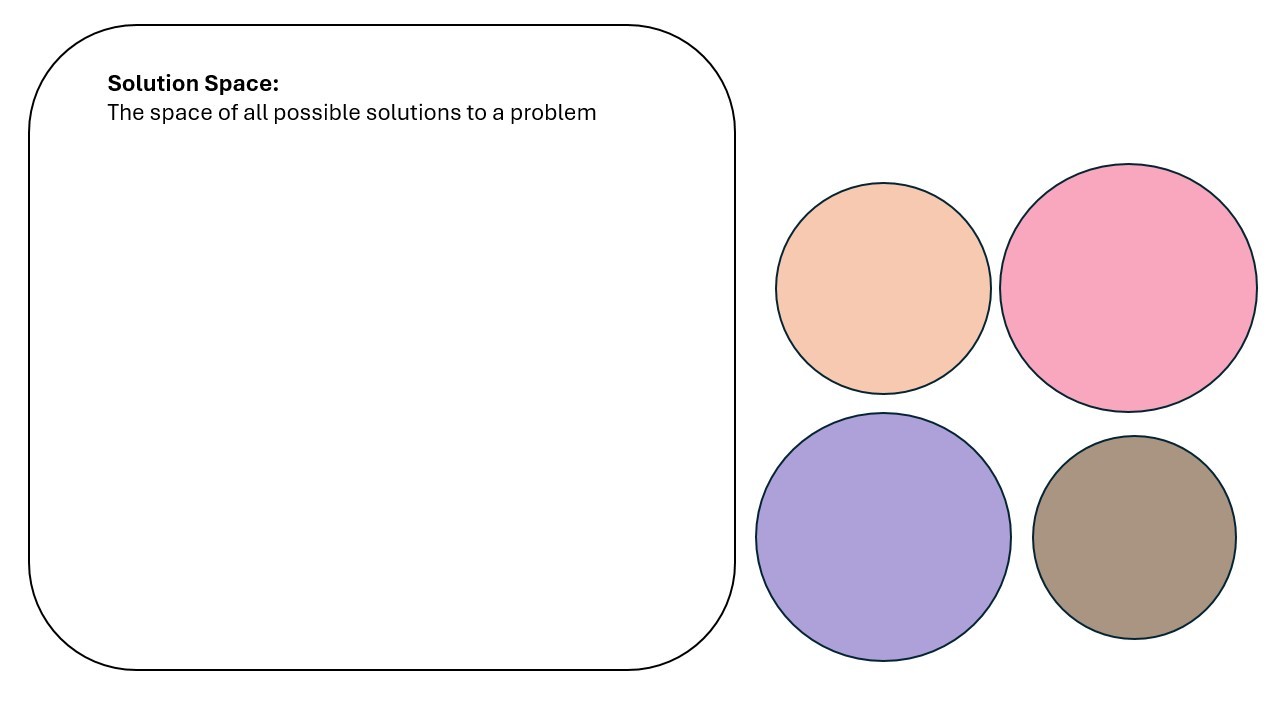
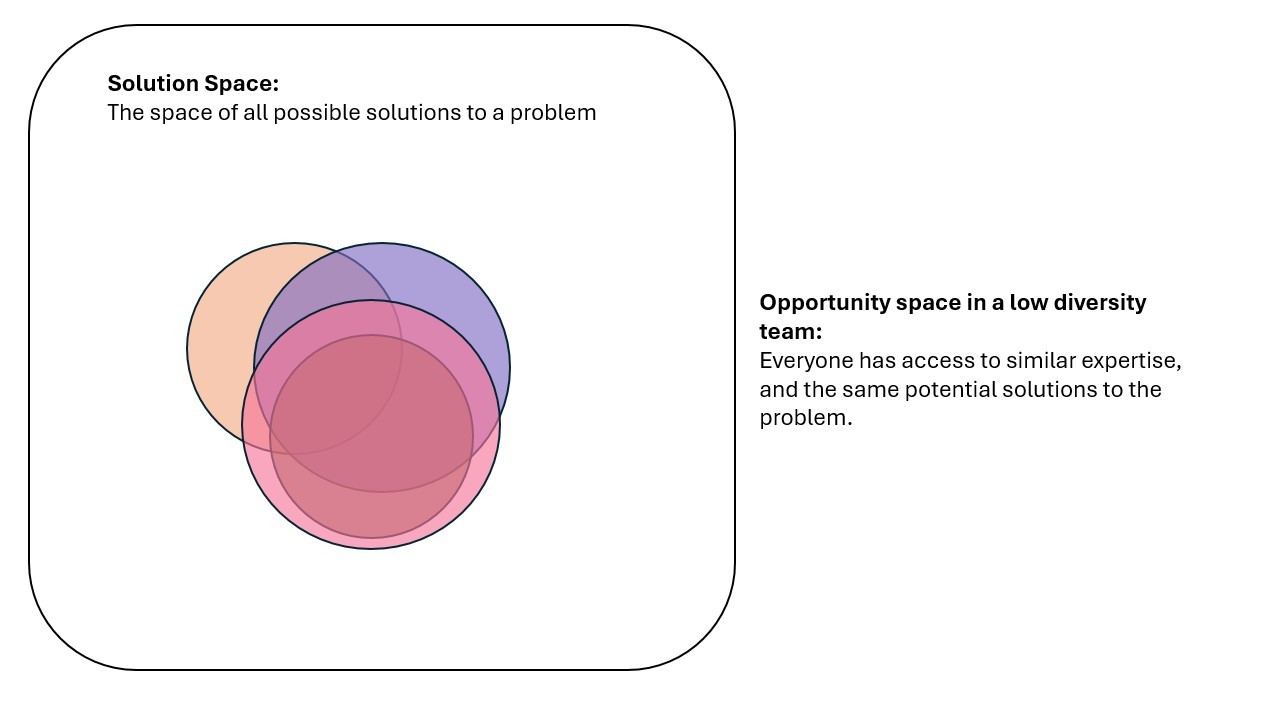
We can visualise how a homogenous team may tackle an ideation task compared to an neurodiverse team. In the image below we can see a potential space of solutions to a problem and shapes representing the range of solutions that four people can access.
The homogenous team composed of individuals with similar training and outlook, clusters tightly around familiar solutions.
In this situation we may see fast agreement on proposed solutions and maybe even a feeling that all avenues have been explored. Some group-think. This group might end up blocked and frozen on top of their own mountain rather than "making for the Gap of Rohan".
The second team includes more cognitive variation and varied expertise. Their ideas map out more broadly, touching novel ground in the solution space. I think we may also get some interesting collaboration at the edges leading to expansions into opportunity space that is not available to any one person alone (the pink bits). We must remember that some of these edge-case ideas will not be very good, but some of them may be revolutionary.
I'm almost presenting a view that a neurodiverse team is a mitigation for groupthink - something that can take hold in organisations where compliance and consensus are socially important. Let's not forget that even with suboptimal solutions for short-term gains, the long-term advantages of simply moving forward with an innovative, yet risky strategy can be very rewarding. To look back to the Fellowship, they would never have entered Moria without Merry helping our Gandalf with abit of Elvish wordplay. Once inside, without waking the Balrog - considered in isolation, it was a complete disaster - Gandalf would never have levelled-up to become "The White". A combination of serendipity and diversity to mitigate the chaos seemed helpful. I think it can be the same in our organisations.
Navigating the Challenges
Just having neurodivergent team members doesn't guarantee innovative outcomes. In fact, without the right environment, it can result in missed opportunities, misunderstood contributions, stress, and burnout. To enable our neurodivergent colleagues to contribute successfully I think there are two main barriers to overcome: acceptance in the organisation and psychological safety, and modifying organisational procedures to reduce the cost and the perceived cost of "experiments", be it the development of a new method, or a new UX.
Psychological Safety
Research into functional diversity shows that the main driver of innovation in teams is having a high informational diversity and free-sharing of that information (short wikipedia summary). However, this can all be for naught when the team has high values diversity - rather than leading to interesting discussions about approaches to a problem, we could see a complete communication breakdown - negating any of the benefits of the high skill and cognitive diversity in the team (Knippenberg et al., 2004). Without a psychologically safe environment to foster the sharing and exploration of risky ideas, the diverse team can be outperformed by the homogeneous one.
Psychological safety is key to encouraging our neurodiverse colleagues. If a team member senses that raising an oddball idea might jeopardise their standing or invite ridicule, then they will suppress it. Lets be clear, many neurodiverse people are hyper vigilant to others' reactions and are adept at socially masking to fit in. The effects of masking can be devastating including isolation, poor physical and mental health, increased stress and the loss of identity (Bradley etal. 2021) Without psychological safety in the team we may lose the edge that could give the team a creative advantage.
Neurodivergent thinkers may also need clarity in communication and structure. Some may prefer written instructions. Others need context to engage meaningfully. A "we should do this" comment might be taken as a plan, rather than a suggestion, depending on how literally someone processes language.
The Perceived Risk and Cost of Failure
There's also the question of buy-in and the perceived cost of new innovative solutions, especially the cost of failure. In most organisations, an idea must survive several layers of review, refinement, and stakeholder approval before it's funded or tested. But if the idea comes from an unconventional thinker, or is poorly understood by someone two levels up, it may be quietly softened or rejected altogether. In those cases, the system has filtered out novelty in favour of consensus. So it is not only the encouragement of psychological safety that is needed, but also the realisation that procedures for "green-lighting" experimentation may actively winnow out the "risky" solutions we should be testing.
We might say that experimenting with innovative approaches requires the cost of failure to be low. By reducing the perceived cost of "failure" we could encourage more innvovative ideas as we could test out the more risky approaches. - and this is where some good product management practices can help. We can explore this in the future.
Wrapping Up
Neurodivergent thinkers expand the possibility space available to the team. Their strengths in pattern recognition, abstraction, intolerance of fuzziness can help our teams frame problems differently and approach problems from entirely different points of view compared with homogenous teams.
Neurodivergent people may not fit into the typical mould for a corporate and the expected way of working and because of this be undervalued in the workplace. Many neurodivergent people experience chronic misunderstanding, burnout, and even exclusion in our organisations. I think any organisation could gain a big advantage by making their workplace, evaluations, and recruitment process more friendly for neurodivergent people.
If your company survives or thrives based on how well it navigates new territory, then attracting the best talent is non-negotiable. By supporting our neurodivergent colleagues and providing the safety to explore innovative approaches, not only do we increase equity, we should find that we gain outsized business benefits.
We've looked here at what makes neurodiverse teams powerful, but that power needs some good initial conditions. In future posts I'll explore how organisations could explore creating conditions that make experimentation safer and less expensive, so divergent and neurotypical thinkers alike have not only feel safe to share their ideas but the permission to test them.