From Thought to Thing in Minutes: AI Prototyping
Jun 30, 2025
After attending a great Product Tank meeting in Birmingham on June 25th I wanted to share some of my views on how AI tools can be used in our Product Practice and some of the potential consequences both good and not so good.
Exploring AI-Enabled Product Prototyping: Opportunities and Limitations
There’s something quite compelling about discovering that, as a product manager, I can now generate viable mock-ups, and even near-MVPs, using AI tooling. Tools like Lovable, Bolt, and V0 make it possible to move from an idea to a pretty prototype in minutes. Claude can now produce working application code directly. This raises important questions about the evolving roles of product managers, engineers, and designers, but let's leave until another time.
I've been exploring how far these tools can take us when building software products. While the potential is significant, so are the limitations. At the recent Product Tank event in Birmingham Yuan Deng, a Product Manager at MHR, showed us how we can use GenAI tools in our Product Practice. Here are my reflections on the key strengths and drawbacks I’ve noticed so far.
The workflow
Yuan began by outlining some of the tools we would use in the session and asking how many of us had used them. To my surprise, a decent number of attendees had experience with them - though fewer had tried V0, this might be expected as v0 has more of an IDE interface.
Yuan described a workflow (figure 1.) that started out with defining a short Product Requirements Document, or taking a small problem statement and providing this as context to an LLM tool, in our case Claude, to generate a first draft of requirements that we would later use as input to the generative AI (genAI) prototyping tool.
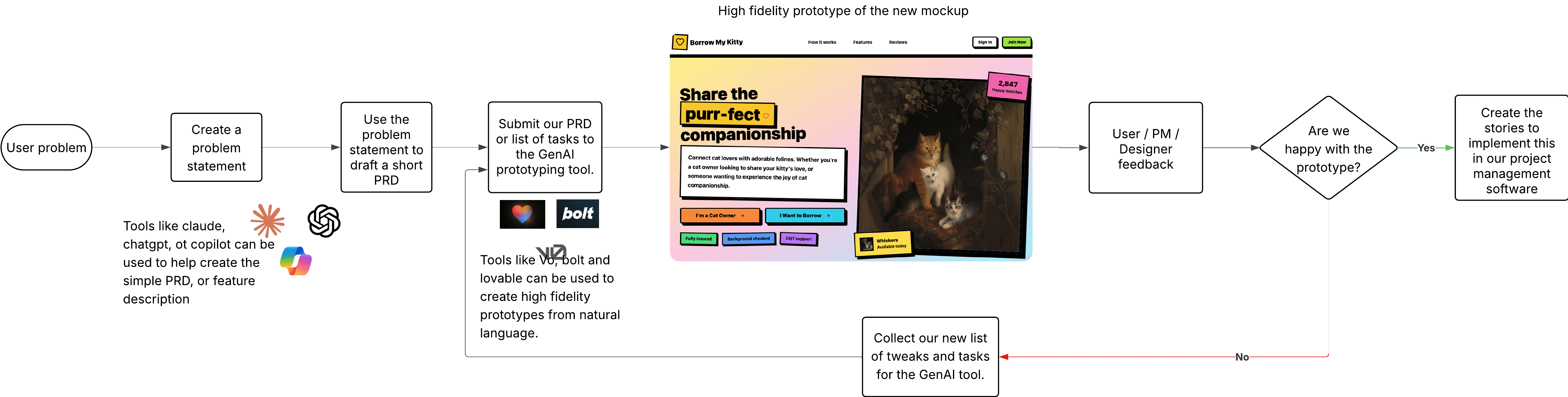
Figure 1. Our product prototype workflow
The next step involved creating our account in vercel's v0 (v-zero) and submitting our PRD with some tweaks coming from Claude. Then v0 with my new free account spent a couple of minutes generating a first pass of the site. In my case, it was to generate an A/B test for a feature in an AirBnb-like site to test the impact of some semantic filters either as drop-down, or as chips in the UI. This worked quite well to give an idea of what the feature should look like for the developers. I did give a couple of tweak prompts. I was able to reference UI components I wanted to edit directly prompt. This seemed to help v0 make the necessary edits. After one iteration I was very happy with the results.
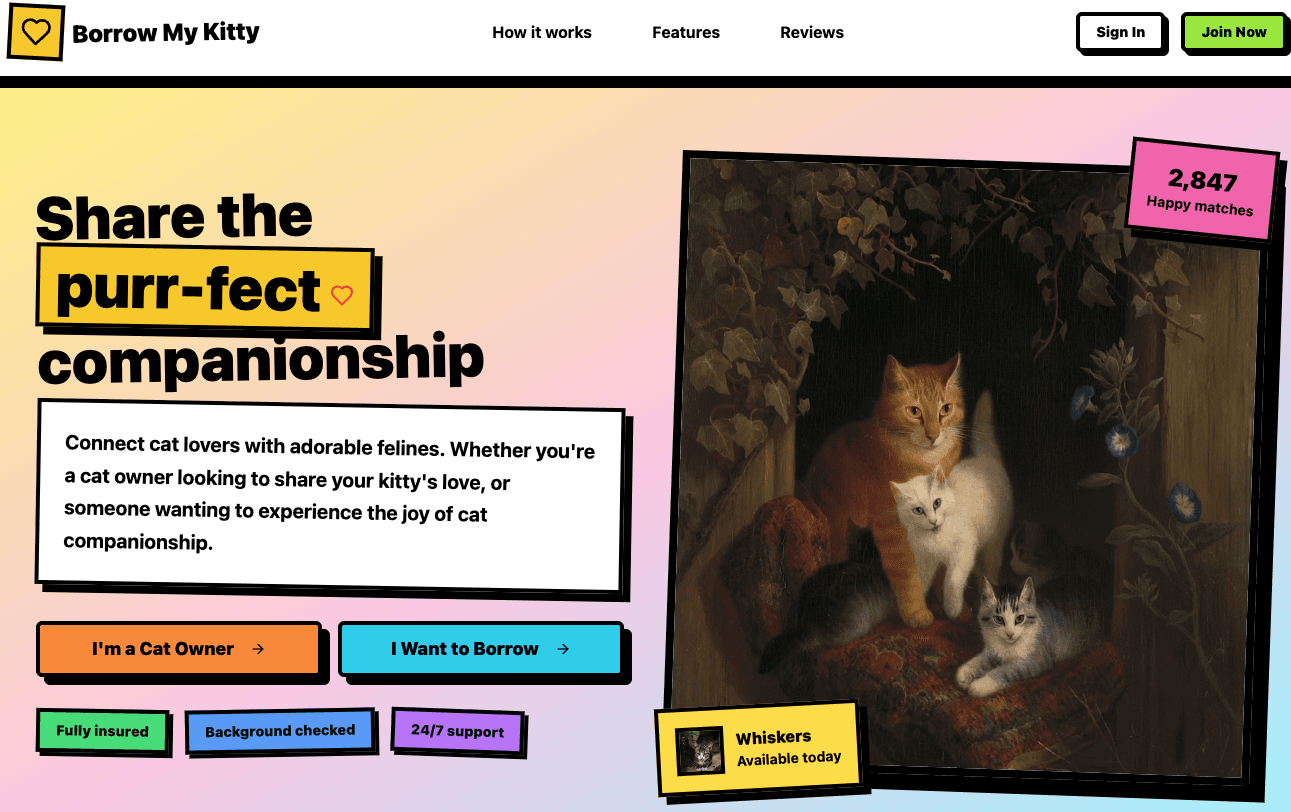
Our final exercise was to create a website equivalent of borrowmydoggy, but for cats instead. We used the same workflow, but used another AI prototyping tool, lovable, instead of v0. During this section of the workshop I noticed that all the prototypes ended up looking almost identical with the same colour themes using modern minimal UI elements. To spice things up I asked lovable to use the "neobrutalism" library instead of standard tailwind elements. I ended up with an quirky, but fun UI shown below. Try clicking to visit the barebones prototype yourself.
neobrutalis(h)t style borrow my cat landing page.
After the session, some of the standout features I wanted to explore further were:
The ability to connect to github so we can easily track code.
This would help to mitigate the common problem of these AI agents overwriting useful functionality when you want to simply tweak a corner case.
Database integration so we can get closer to MVP.
Yuan showed how we can connect to supabase and mock up our own customer connection database for "borrow my cat".
What Works Well
Faster communication of intent: AI tools allow product managers to express product ideas quickly and clearly. This speeds up ticket writing and stakeholder alignment.
Rapid iteration: Prompted with a well-formed problem statement or PRD, these tools can sometimes generate working features. You can make incremental changes and immediately see how they affect functionality and flow.
Lower experimentation barrier: When the cost of building and testing ideas drops, it's easier to explore bolder directions. This encourages creativity and early risk-taking that may have been unfeasible in traditional workflows.
Access to niche opportunities: Tools that were once too expensive to build for small audiences are now much more feasible to prototype and validate.
New possibilities for user-facing sessions: Real-time editing and branching of prototypes in user interviews or workshops could accelerate time-to-validation and help teams converge on effective solutions faster.
Some less than ideal consequences
Security concerns: Without a developer reviewing critical features like authentication, there’s no guarantee that the system is secure. It’s difficult to know if sensitive data is being handled properly - or worse, leaked.
Maintainability issues: The generated code tends to be inconsistent. I’ve seen strange folder structures, duplicated class names, and no test coverage. It’s good enough to run, but not necessarily to scale or maintain.
Risk of over-reliance: AI tools are impressive, but they can encourage passive thinking. If we're not careful, we risk outsourcing problem-solving itself, trusting tools without really understanding their decisions.
Reduced developer input: Highly specific mockups may reduce the scope for engineers to contribute creatively to product solutions. While this might seem efficient, it risks turning collaborative work into instruction-following.
Design monoculture: As LLMs are trained on broadly available datasets, their outputs tend to reflect the average. The risk is a growing uniformity in design. Over time, distinctive, high-quality interfaces may become harder to surface or justify.
Pacing mismatch with users: As development cycles shorten, companies may begin shipping features faster than users can meaningfully absorb them. This can erode user trust and product stability.
Final Thoughts
AI tooling has significantly lowered the cost of product prototyping. This has real benefits for experimentation, communication, and iteration. In the short term, it may be more democratising than disruptive - giving product teams more flexibility to test ideas and collaborate at speed.
However, these tools are best used as support, not substitution. Deep domain knowledge, thoughtful design, and solid engineering remain essential. As the barriers to building come down, the value of clear thinking, creative problem solving, and good judgment goes up. If your users and domain experts were important to you, their impact has increased as the barrier to entry for software creation has reduced.
Ultimately, AI-enabled prototyping is a powerful addition to the product toolbox - but not a replacement for product craft.